
Messaging
Messaging
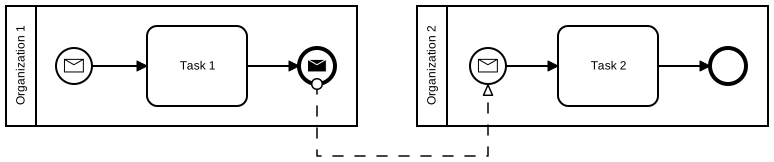
Enabling communication with other lanes, pools or even entirely separate processes requires the ability to exchange information. In BPMN, Message Events and Message Send Tasks are used to model this information exchange. Using them to model communication in the same diagram uses Message Flow. Message Flow is typically represented by a dashed line arrow between BPMN elements with a black (send) or white (receive) envelope icon. The following BPMN collaboration diagram shows message exchange between two processes.
Message Start Event
Message Start Events allow a BPMN process to be started by an incoming message. In the DSF, all BPMN processes are started via messages. Therefore, it is mandatory to include a Message Start Event at the beginning of all DSF BPMN models.
Message Intermediate Throwing Event
Message Intermediate Throwing Events are used to send messages during process execution. Message intermediate throwing events that are used to communicate with DSF instances via FHIR Task resources, should implement the DSF API v2 interface dev.dsf.bpe.v2.activity.MessageIntermediateThrowEvent.
Message Intermediate Catching Event
Message Intermediate Catching Events serve as the counterpart to Message Intermediate Throwing Events. They are used to receive a message from another process or organization during execution.
Message End Event
The Message End Event will stop the execution of a BPMN process and finish by sending a message.Message end events that are used to communicate with DSF instances via FHIR Task resources, should implement the API v2 interface dev.dsf.bpe.v2.activity.MessageEndEvent.
Message Send Task
Same as the Message Intermediate Throwing Event, the Message Send Task is used to send messages during process execution but is also intended to execute some kind of business logic at the same time. Message send tasks that are used to communicate with DSF instances via FHIR Task resources, should implement the API v2 interface dev.dsf.bpe.v2.activity.MessageSendTask.